

What is ASTM? A Plain-English Guide for Homeowners
If you've spent any time on this site, you've seen us mention ASTM C1036. It shows up in nearly every page we've written, and most homeowners have never heard of it. That's on us to explain, not on you to already know. Here's what it actually means, and why it matters when someone is telling you whether your glass needs to be replaced or can be restored.
ASTM stands for the American Society for Testing and Materials — now officially called ASTM International. It's a nonprofit organization that has been writing voluntary, consensus-based technical standards since 1898, covering everything from steel to concrete to, in our case, glass. ASTM doesn't sell anything and doesn't manufacture anything. Its standards are developed by committees of engineers, manufacturers, and industry experts, and they become the common language an entire industry agrees to use so that "good quality" isn't just one company's opinion.
Here's the real reason ASTM exists: no piece of glass, or any manufactured material, is ever going to be 100% perfect. Every industry has to draw a line somewhere between "this is a normal, acceptable imperfection" and "this is a defect." Without that line, every minor blemish turns into an argument — homeowner versus contractor, contractor versus manufacturer, all the way to a courtroom if nobody agrees. ASTM was built to prevent exactly that. It defines the "Allowable Imperfection" — the specific, measurable point where a mark on the glass is considered normal and acceptable versus where it crosses into a real defect. And it wasn't written by one side trying to protect its own interests. It was written by equal parts manufacturers, retailers, installation companies, and end users — the people who make the glass, the people who sell it, the people who install it, and the people who live with it. That balance is what makes it a standard everyone can actually trust, instead of a rule one side wrote to favor itself.
ASTM C1036 is the specific standard that applies to flat glass — the standard that defines what counts as an acceptable optical and cosmetic blemish versus a defect serious enough to require replacement. It sets objective limits on things like scratches, digs, bubbles, and other surface imperfections, measured by size and how many are allowed within a given area of glass. It's the same standard glass manufacturers, architects, and glazing contractors use nationwide.
Here's why that matters to you directly: when someone tells you your scratched window "has to be replaced," ASTM C1036 gives you an actual, objective benchmark to measure that claim against — instead of just taking a salesperson's word for it. Glass Restoration Inc. uses the ASTM C1036 standard to evaluate every job. If a scratch or blemish falls within what the standard defines as restorable, we restore it on-site. If damage genuinely exceeds what restoration can correct, we tell you that too — the same standard, applied honestly either way.
Why This Matters More Than You'd Think
Full glass replacement is expensive, has long lead times, and generates unnecessary waste when the damage doesn't actually require it. Having an objective standard — rather than a subjective "that looks bad enough to replace" — protects you from paying for a full replacement when restoration would have solved the problem to the same recognized quality benchmark used across the industry.
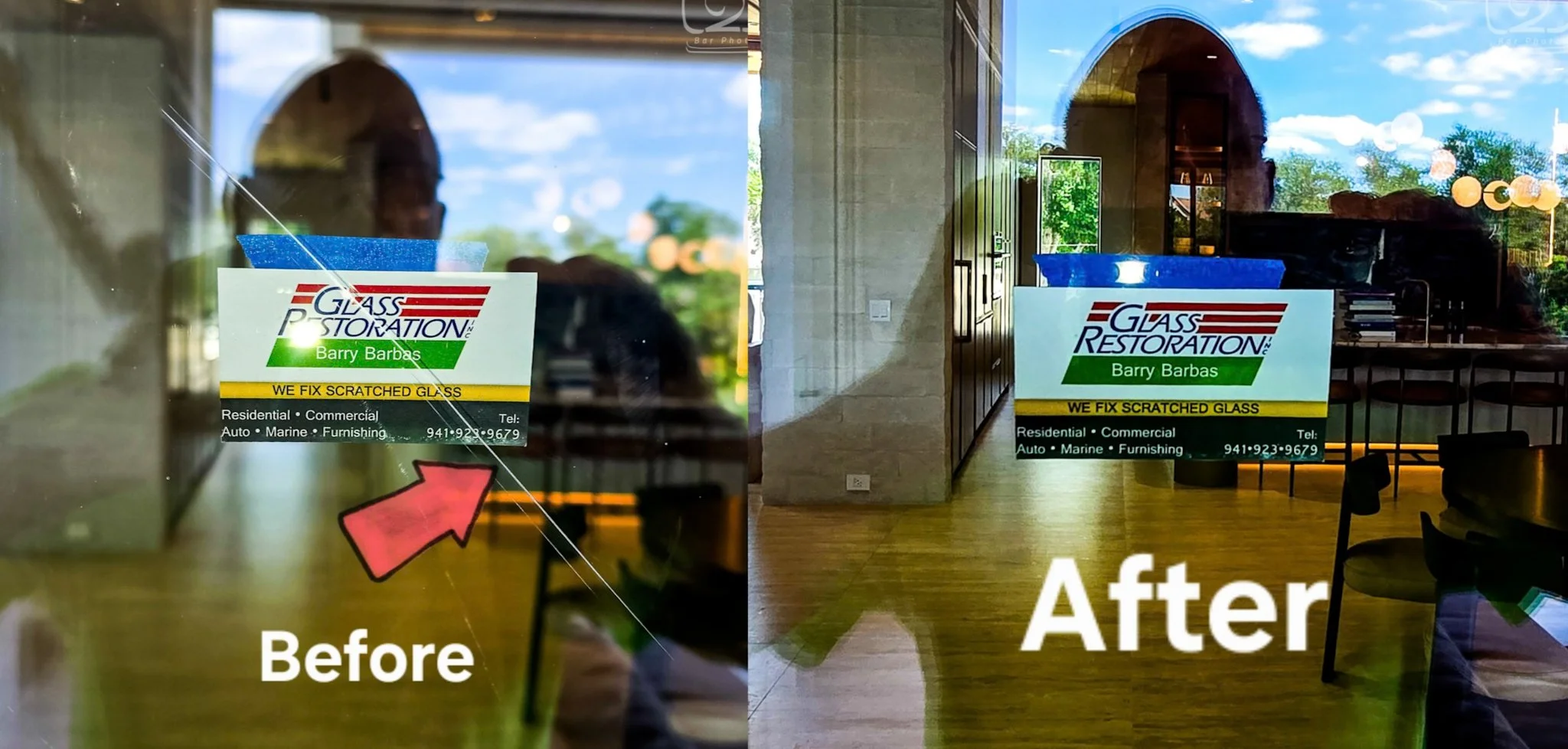
This deep scratch would never pass ASTM C1036's allowable imperfection standard — an obvious defect, not a normal blemish. Watch the full on-site restoration process, from deep damage to true optical clarity, without replacing the glass. (0:52)
Some distortion is common and passes ASTM standards, Others do not, and can be caused by improper restoration techniques. That is exactly why a skilled, experienced technician is needed. 0:29 Sec.

A 3-inch long scratch this deep fails ASTM's optical clarity standard outright — no argument needed. Glass Restoration Inc. restored this impact slider on-site, back to factory-clear condition, without a costly full-panel replacement. (0:56)
Other Imperfections
Scratches and blemishes aren't the only thing ASTM's flat glass standard weighs in on — distortion is its own separate category, and it's just as important. Distortion is what happens when the glass surface itself gets warped or wavy, bending the light passing through it and visibly bending or blurring whatever you're looking at on the other side. A minor amount of natural waviness is expected in any piece of glass and falls within the allowable range. But when a repair is done with the wrong tools, the wrong technique, or too much heat and pressure in one spot, it can push the glass past that allowable range and into a defect that's arguably worse than the original damage. We recently posted a video showing exactly this: a scratch that started out completely repairable on a $10,000 entrance door was turned into a full replacement job after a competitor's repair attempt left the glass badly distorted. The scratch alone would have passed a restoration standard. The distortion left behind afterward did not.
Where to Buy the Official ASTM Standard
If you want to read the actual ASTM C1036 standard for yourself, rather than take our word for what it says, ASTM International sells official copies directly through their website at store.astm.org. Search for "C1036" to find the current edition covering flat glass, or search for "C1651" for the standard specifically covering optical distortion in heat-treated glass. ASTM vigorously defends their copyrights. Therefore, we cannot copy and share the documents that we purchased, but can describe the standards that apply to your project. Everyone who deals with glass professionally should own a copy of the ASTM 1036 documents. These are the same documents referenced by manufacturers, architects, and glazing contractors nationwide — nothing about them is secret or exclusive to the industry. To purchase, visit www.astm.org.
When Damage Happens After the Sale — Who is Responsible?
ASTM C1036 covers blemishes that begin at manufacturing and carry through installation, ownership, and everyday life with the glass — the standard follows the glass, not just the sale. Once an owner takes control of a property and cleans the glass themselves, or hires a cleaning crew, painters, or other trades to do work around it, the manufacturer and the builder are generally released from responsibility for whatever happens after that point. But the standard doesn't disappear along with that liability shift — it's still the document a homeowner or building owner can point to when a dispute comes up with whoever they hired. If a cleaner, painter, or contractor damages glass beyond what ASTM allows, the standard is exactly what defines whether that damage is a normal, acceptable risk of the work or a real problem they're responsible for. Glass Restoration Inc. has been hired directly by cleaning companies, painting contractors, and other trades who accidentally affected glass quality on a job — because the same standard that protects a homeowner also gives a contractor a clear, objective way to resolve the claim instead of guessing.
When ASTM Becomes Evidence — Expert Witness Consulting
ASTM C1036 isn't just a reference standard we use to decide whether a scratch is restorable — it's also the same standard we're called on to apply in construction defect litigation, when glass damage becomes a disputed claim between a builder, a subcontractor, and an insurer. Barry Barbas serves as a defense-side expert witness on construction defect matters involving glass damage, using ASTM's allowable imperfection standard to give an objective, defensible answer to a question that often ends up in front of a judge: was this glass actually damaged beyond the standard, or not, as well as answer the question: Can this glass be restored back to ASTM standards. To learn more about that work on our Expert Witness Consulting page, click the link below.