
If you are A builder, superintendent, or project manager whose crews apply protective film at framing and don't revisit it until punch list — by which point months of Florida sun have already done their work on east and west facing glass.
A homeowner in a new construction community who moved in and noticed the blue film was already partially bonded or coming off in pieces when the cleaning crew tried to remove it.
A property manager or HOA managing a building where window cleaning contractors have reported that the film won't come off cleanly — and someone has already reached for a scraper.
A window cleaning professional who has been handed a building with baked-on film and needs to understand what you're dealing with before you touch it.
When the Protector Becomes the Enemy — How Construction Protective Film Destroys the Glass It Was Designed to Save
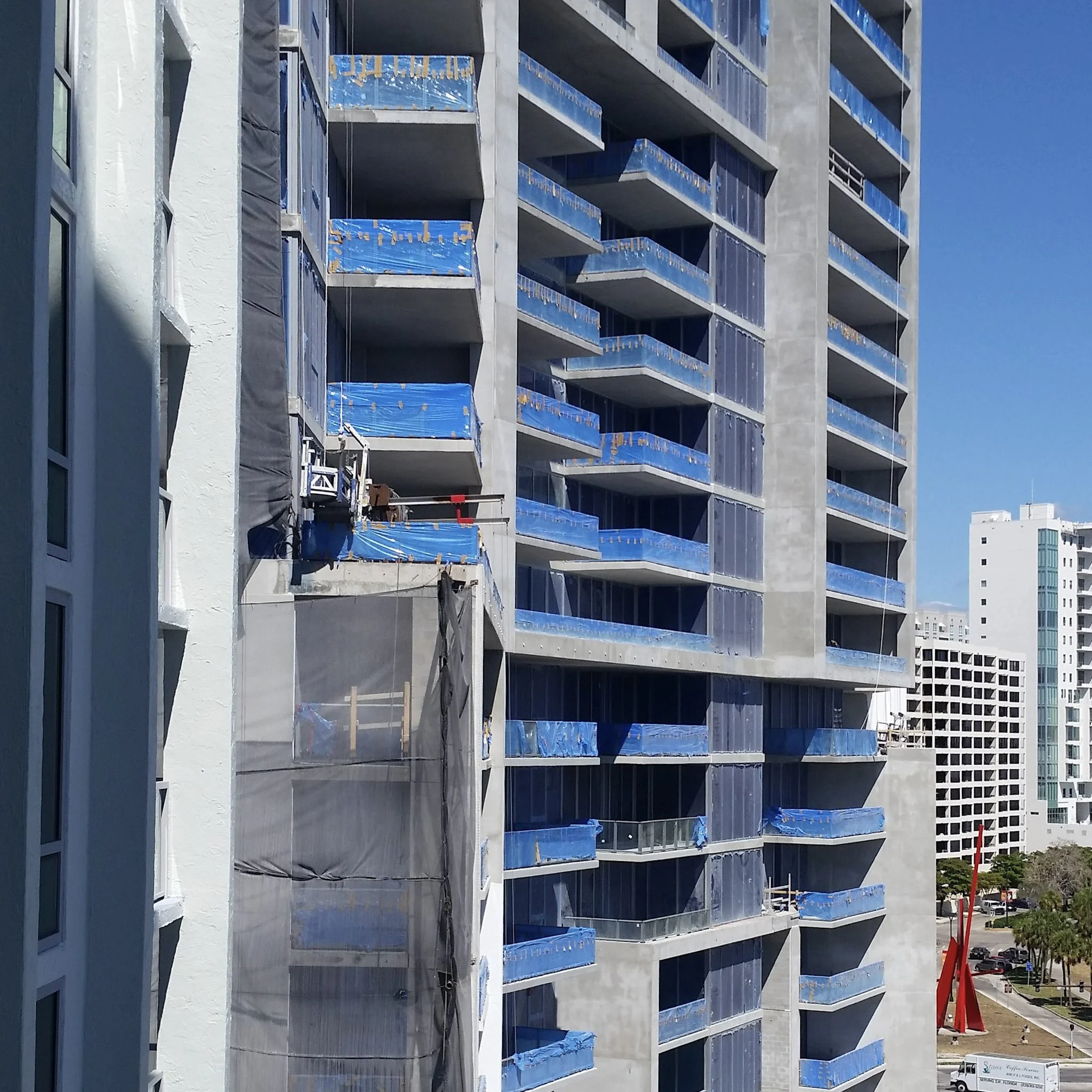
The Film on Your Glass Has an Expiration Date — And Nobody Is Watching the Clock
Protective construction film is not a single product. It is a category with dozens of brands, each with its own adhesive chemistry, UV resistance rating, and manufacturer-specified removal window. What they all have in common is this — every single one of them has a removal deadline, every single one of them prints it on the packaging, and on the vast majority of Florida construction sites, that deadline passes without anyone noticing.
What the Manufacturers Actually Specify
The removal timelines vary significantly by brand and product — which is itself part of the problem. When a crew applies whatever film was ordered that week without reading the label, they have no idea whether they are working with a 30-day product or a product rated for a year. Here is what the major brands actually specify:
TapeManBlue Window Protection Film — maximum 60 days. The manufacturer specifically recommends writing the application date on the corner of the film at installation as a reminder. Almost nobody does this.
ArmorDillo Blue Window Protection Film — 45-day UV resistance rating for window film. The product description warns that outdoor exposure may severely shorten the usable period.
BlueGuard PVC Window Protection Film — rated for up to one year under ideal conditions. This extended rating exists because BlueGuard uses a low-tack PVC adhesive rather than a standard acrylic. However the manufacturer specifies removal above 50°F and notes that warm conditions enhance adhesion bond strength — meaning Florida's heat actively works against clean removal even on their longest-rated product.
Trimaco Easy Mask — 30 days for hard surfaces. Window film follows the same general range.
Cardinal Glass Preserve — factory-applied film rated for removal within 6 months of installation. Cardinal specifically states the film should not be pressure washed and notes that failure to remove within the recommended period leads to damage.
The range is 30 days to 6 months depending on brand, product type, and whether it has UV inhibitors. And here's the critical detail — most of the cheaper films available at Home Depot and Amazon are interior-rated without UV inhibitors. When a subcontractor grabs a roll off the shelf without reading the label, there's a good chance they're using an indoor product on east or west facing Florida glass. That product was never designed for what it's being asked to do.
Every one of these timelines assumes conditions that Florida construction sites do not provide. UV intensity on the Gulf Coast is among the highest in North America. East and west facing glass receives direct sun exposure during the most intense hours of the day. Ambient temperatures routinely exceed 90 degrees from April through October. The adhesive chemistry that allows clean peeling at 60 days in a Pennsylvania warehouse behaves completely differently after 60 days of Florida sun on a West-facing high-rise. The timeline on the label is not a lie — it is simply not written for every extreme climate and condition.
READ AND FOLLOW THE MANUFACTURER'S INSTRUCTIONS ON EVERY PRODUCT APPLIED TO YOUR GLASS.
Walk into any Home Depot, industrial supplier, or construction materials warehouse in Florida and you will find blue protective film. It comes from a dozen different brands — TapeManBlue, Surface Shields, Trimaco, ArmorDillo, Blueguard, and many others — in rolls of varying thickness, adhesive strength, and UV resistance. What almost none of the people buying it realize is that each product has a completely different removal timeline, and that several of the most commonly purchased options are rated for indoor use only — meaning they were never engineered to handle direct Florida sunlight at all.
The removal timelines vary dramatically by brand and product. TapeManBlue's window film is rated for 60 days maximum and the manufacturer actually recommends writing the application date on the corner of the film as a reminder — because they know it gets forgotten. Surface Shields specifies 30 to 45 days. Trimaco rates their adhesive films at 30 to 60 days and explicitly warns against applying their products to windows receiving direct sunlight. Cardinal Glass's own Preserve film — factory applied to their glass — specifies removal within six months of installation. Six months is the longest rated timeline in the market. Most products on the shelf are rated for far less.
The problem is compounded by the fact that interior-rated films — products without UV inhibitors built into the adhesive — are sold right alongside exterior-rated products on the same shelf, in nearly identical packaging. Surface Armor, one of the leading glass protection film suppliers, explicitly warns that interior-rated films without UV inhibitors could adhere too strongly if exposed to sunlight for extended periods. When a subcontractor grabs a roll without reading the technical data sheet, there is no guarantee they are using a product rated for the Florida sun it will be exposed to every day until someone remembers to remove it.
Not All Blue Film Is the Same — And Nobody Is Reading the Label
Walk into any Home Depot, industrial supplier, or construction materials warehouse in Florida and you will find blue protective film. It comes from a dozen different brands — TapeManBlue, Surface Shields, Trimaco, ArmorDillo, Blueguard, and many others — in rolls of varying thickness, adhesive strength, and UV resistance. What almost none of the people buying it realize is that each product has a completely different removal timeline, and that several of the most commonly purchased options are rated for indoor use only — meaning they were never engineered to handle direct Florida sunlight at all.
The removal timelines vary dramatically by brand and product. TapeManBlue's window film is rated for 60 days maximum and the manufacturer actually recommends writing the application date on the corner of the film as a reminder — because they know it gets forgotten. Surface Shields specifies 30 to 45 days. Trimaco rates their adhesive films at 30 to 60 days and explicitly warns against applying their products to windows receiving direct sunlight. Cardinal Glass's own Preserve film — factory applied to their glass — specifies removal within six months of installation. Six months is the longest rated timeline in the market. Most products on the shelf are rated for far less.
The problem is compounded by the fact that interior-rated films — products without UV inhibitors built into the adhesive — are sold right alongside exterior-rated products on the same shelf, in nearly identical packaging. Surface Armor, one of the leading glass protection film suppliers, explicitly warns that interior-rated films without UV inhibitors could adhere too strongly if exposed to sunlight for extended periods. When a subcontractor grabs a roll without reading the technical data sheet, there is no guarantee they are using a product rated for the Florida sun it will be exposed to every day until someone remembers to remove it.
The Florida Factor — Why Every Timeline Gets Shorter Here
Every removal timeline on every product label was established under standard test conditions — not under the UV intensity of the Florida Gulf Coast, where the sun angle, heat index, and humidity create an environment that accelerates adhesive degradation faster than almost anywhere else in the country. East and west facing glass receives direct low-angle sun in the morning and afternoon respectively — the most intense and sustained UV exposure on a building. A film rated for 60 days in a laboratory or a moderate climate may begin bonding chemically to glass in half that time on a west-facing sliding door in Sarasota in July. The label tells you the best case. Florida gives you the worst case. The gap between those two things is where the damage happens.
What Happens to the Glass When the Film Is Left Too Long
Protective film damage is not a single event. It is a progression — and like the concrete hydration cycle, each stage that passes without intervention makes the next stage harder to reverse. Understanding where the glass is in that progression determines whether restoration is possible and what it will take.
In the early weeks after the removal window has passed, the adhesive backing begins to soften and migrate under heat. The film may still appear intact from a distance but the bond between the adhesive and the glass surface has begun to strengthen beyond its designed release point. At this stage the film can still be removed with patience and the correct technique — warm water, a plastic scraper at a shallow angle, and time. No glass damage results if the right approach is used. Most crews skip this stage entirely because the film still looks fine and nobody has checked the calendar.
Stage 2 — Adhesive Transfer
As UV exposure continues, the adhesive layer begins to separate from the film backing and transfer directly onto the glass surface. The film now comes off in pieces rather than sheets — tearing rather than peeling. What remains on the glass after the film fragments are removed is a cloudy, tacky adhesive residue that has chemically bonded to the surface. Standard glass cleaners will not remove it. Solvents can damage surrounding seals and frames. At this stage the removal process becomes genuinely labor intensive — and this is the moment when most workers reach for a metal scraper. That decision is where the glass gets permanently scratched.
Stage 3 — Mechanical Damage
Once a scraper enters the picture, the damage moves from the film to the glass itself. A metal blade dragged across glass surface with adhesive residue acting as an abrasive compound produces scratches that range from surface-level haze to deep gouges depending on the pressure applied and the number of passes made. The film — the product that was supposed to protect the glass — has now become the direct cause of the damage it was designed to prevent. The protector has become the enemy. And the scratches left behind are not a cleaning problem. They are a glass restoration problem.
Stage 4 — Baked-On Bonding
In the most advanced cases — typically glass that has been through multiple summer heat cycles with film still attached — the adhesive has fully cross-linked with the glass surface through a combination of UV exposure and thermal cycling. The film and its adhesive are no longer a layer on top of the glass. They have become part of the surface chemistry. Removal at this stage requires professional assessment before any attempt is made. Aggressive removal without a clear protocol risks permanent scratching, and in cases where the adhesive has penetrated micro-surface irregularities in the glass, full removal to a factory-clear finish may require mechanical polishing regardless of the removal technique used.
The single most important thing anyone can do to prevent construction film damage is also the simplest: READ AND FOLLOW THE MANUFACTURER'S INSTRUCTIONS.
How to Prevent Construction Film Burn — The Protocol That Protects Your Glass
READ AND FOLLOW THE MANUFACTURER'S INSTRUCTIONS ON EVERY PRODUCT APPLIED TO YOUR GLASS.
Prevention is entirely within the control of the builder, superintendent, or homeowner — but only if it begins before the removal window closes. The following protocol applies from the moment protective film is applied to any glass surface on a construction or renovation project through the date the film is removed and the glass is inspected and accepted.
Know What Product Is on Your Glass
Before a single roll of protective film is applied on your project, identify the brand and read the manufacturer's removal specifications. TapeManBlue specifies 60 days. ArmorDillo specifies 45 days. Trimaco specifies 30 days for hard surfaces. BlueGuard is rated for up to one year but carries specific temperature and condition requirements that Florida's climate directly challenges. Cardinal Glass Preserve specifies six months. These are not interchangeable timelines — and the film applied by your subcontractor may not be the same brand used on the last project. READ AND FOLLOW THE MANUFACTURER'S INSTRUCTIONS.
Mark the Removal Date at Application
TapeManBlue recommends writing the application date directly on the corner of the film at installation. This is sound practice for every brand on every project. On large projects with multiple phases — framing, rough trades, drywall, paint, finish work — glass that was filmed at framing can easily reach its removal deadline before finish trades have even started. A date written on the film is visible to every trade on the site and removes the ambiguity of "I thought someone else was tracking it."
Treat East and West Facing Glass as High Priority
On the Florida Gulf Coast, east and west facing glass receives the most intense direct UV exposure of any orientation. Glass facing these directions should be treated as having a shorter effective removal window than the manufacturer's stated maximum — regardless of the brand. If the label says 60 days, treat east and west facing glass as a 30-day priority. The UV intensity and thermal cycling in this climate are not the conditions under which laboratory removal timelines are established.
Inspect and Replace Rather Than Leave in Place
If a project timeline extends beyond the manufacturer's removal window, the correct protocol is to remove the existing film before it bonds and reapply fresh film — not to leave the original film in place and hope for the best. Reapplication is a minor line item on a construction budget. Restoration of bonded film damage, or replacement of scratched glass, is not.
Never Use Metal Scrapers for Film Removal
Regardless of how bonded the film appears, metal scrapers should never be the first tool used for protective film removal. Warm water applied generously to the film surface softens the adhesive and allows fragments to be lifted with a plastic scraper at a shallow angle. If the film has progressed beyond Stage 2 bonding and warm water and plastic tools are not producing results, stop and call a professional before reaching for metal. The glass can almost certainly still be saved at that point. Once a metal scraper has been dragged across bonded adhesive residue, the damage calculus changes entirely.
When Prevention Didn't Happen — What Restoration Can and Cannot Do
If the film has already bonded, fragmented, or been attacked with a scraper, prevention is no longer the conversation. The question now is whether the glass can be saved — and the answer depends entirely on which stage the damage has reached and whether metal has already been introduced to the surface. What follows is an honest assessment of what professional restoration can and cannot accomplish at each stage.
Stage 1 and Early Stage 2 — Fully Restorable, Generally…
If the film is still largely intact but past its removal window, or if adhesive transfer has begun but no scraper has been used, professional removal using the correct solvent-free technique followed by light mechanical polishing will typically restore the glass to factory-clear condition. The adhesive has not yet fully cross-linked with the glass surface and the silica structure beneath remains intact. This is the best possible scenario for a restoration call and the outcome is predictably excellent.
Stage 2 With Scraper Damage — Restorable in Most Cases
This is the most common scenario we encounter on Gulf Coast construction sites. The film has fragmented, someone has used a metal scraper to accelerate removal, and the glass now has visible scratches ranging from light haze to defined linear marks. In the majority of these cases the scratches are surface-level and fall within the allowable tolerances established by ASTM C1036. Professional mechanical polishing removes the scratches entirely and restores optical clarity without replacement. The critical variable is whether the scraper was used once by someone who stopped when they saw the damage, or repeatedly by someone who didn't. Depth and extent of scratching determines the outcome — which is why a professional assessment before any further action is essential.
Stage 3 and Stage 4 — Assessment Required Before Any Action
When film has been through multiple heat cycles in a fully bonded state, or when aggressive scraper use has produced deep gouges rather than surface scratches, a professional on-site assessment with calibrated depth-gauging tools is required before any restoration attempt begins. We establish a Go/No-Go threshold on every job of this type — measuring actual scratch depth against the ASTM C1036 allowable tolerance for the specific glass in question. If the damage is within tolerance, restoration proceeds. If it is not, we tell the client honestly and clearly before a single polishing pass is made. There is a point of no return on glass, and we will not cross it.
The Scraper Is Not the Last Word
One of the most common calls we receive begins with "someone used a scraper and now the glass is ruined." In the majority of those cases, the glass is not ruined. It is scratched — and scratched glass is what we restore every day. The fingernail test that most people use to assess scratch depth is not an accurate gauge of restorability. We have successfully restored glass that catches a fingernail on every single job we do. Do not assume the glass is beyond saving before a professional has assessed it with the right tools. The protector became the enemy — but that does not have to be the end of the story.
Is Your Glass Already Showing the Signs?
If you are managing a construction project where protective film has been on the glass longer than the manufacturer's removal window, do not wait for the damage to worsen before making the call. The difference between a Stage 1 assessment and a Stage 3 assessment is often the difference between a straightforward restoration and a conversation about replacement.
If the film has already fragmented, if adhesive residue is visible on the glass, or if a scraper has already been used — call before anyone touches it again. Glass Restoration Inc. offers professional on-site assessments across the entire Florida Gulf Coast from Naples to Tampa. We will examine the glass, identify the stage of damage, assess restorability against ASTM C1036 tolerances, and give you a clear, honest answer about what can be done, what it will cost, and what the alternative is. There is no charge for the assessment and no obligation to proceed.
We have restored film-damaged glass on luxury high-rises, new construction estates, commercial storefronts, and yacht enclosures across the Gulf Coast. We know what this damage looks like at every stage because we see it every week. And we know exactly when to say yes and when to say no.
READ AND FOLLOW THE MANUFACTURER'S INSTRUCTIONS. If it is already too late for that — we are the call to make.