
When Glass Cannot Be 100% Saved — Honest Assessments from 40 Years of Experience
Glass Restoration Inc. has built its reputation on saving glass that others say cannot be fixed. We do that every day. But honesty requires us to also document the conditions where full restoration is not always possible — where the damage is structural, chemical, or thermal in nature and standard polishing alone may not produce a perfect result. In some of these cases we can improve the condition significantly — reducing visibility, improving optical clarity, and achieving an acceptable standard that avoids replacement. In others the damage is truly beyond any intervention. This page exists because you deserve a straight answer before anyone starts working on your glass.
These are not common conditions. The vast majority of glass damage we encounter is fully restorable. But when these specific conditions are present — the result of construction negligence, industrial accident, or manufacturing defect — the answer is rarely simple. Sometimes we can fix it completely. Sometimes we can improve it to an acceptable standard. Sometimes the honest answer is replacement. Knowing the difference between those three outcomes is the mark of a true specialist. After 40 years in this trade Barry Barbas can identify each condition on-site within minutes and give you an honest assessment of exactly which category your glass falls into — before any work begins.
Oil Canning — Visual Distortion That Cannot Be Polished Away
What It Looks Like
Oil canning in glass is a visual distortion — a waviness or rippling across the surface of a glass pane that creates a warped reflection resembling ripples on water or the sides of a traditional metal oil can. You will not see scratches. Instead you see distorted reflections — straight lines like window mullions or tree branches appear bent, rippled, or wavy when viewed from certain angles. In some cases, where two panes of glass are pushed slightly too close together due to pressure imbalances, you may observe Newton's Rings — concentric bands of rainbow color radiating outward from the point where the two surfaces come closest together.
Newton's Rings are named for Sir Isaac Newton, who documented and measured the pattern in the 1660s and 1670s, though the phenomenon itself was observed slightly earlier by Robert Hooke. The rings form through optical interference: light reflecting off the inner surface of one pane and light reflecting off the facing surface of the other pane travel very slightly different distances before reaching your eye, and depending on the exact gap between the two surfaces at that point, those light waves either cancel each other out or reinforce each other — which is why the pattern shows color and shifts as the angle or gap changes, even though the glass itself is perfectly clear. Because both oil canning and Newton's Rings come from the shape of the glass or its relationship to a neighboring pane — not from damage to the surface — no amount of polishing, buffing, or scratch restoration will resolve them. The glass has to be re-spaced, reset, or replaced to correct the underlying pressure or manufacturing issue causing the distortion. It looks like oil, but is actually a prism affect happening on a small circular scale.
What Causes It
Oil canning is triggered by heat and pressure, not by any actual liquid movement inside the glass. Heat generated during polishing, direct sunlight, or even the pressure of touching and pushing on a thin pane causes it to flex ever so slightly — enough to distort the reflection without changing anything else about the glass itself. It isn't moving like a liquid; it's behaving the way any thin, rigid material does under stress, the same way a sheet of metal will bow and ripple under a hand's pressure without melting or becoming fluid. That flex is temporary in cause but the visual distortion it leaves behind is effectively permanent, which is why oil canning shows up far more often on thinner, large-format panes and insulated glass units than on smaller or thicker ones.
Can It Be Fixed?
Oil canning cannot be polished away because the distortion is not on the glass surface — it is within the glass structure itself or caused by external pressure on the unit. No surface restoration process addresses internal stress patterns or IGU pressure imbalances. In most cases the honest answer is that the glass unit needs to be replaced with a thicker outer pane — typically 5/16 inch instead of the standard 1/4 inch — which significantly increases stiffness and reduces reflective waviness. In some cases adjusting the glazing and frame fit can reduce the effect. But if you are seeing oil canning and hoping surface polishing will solve it — it will not. Glass Restoration Inc. will tell you this on the first call rather than take your money on a job that cannot produce the result you need.
Welder Slag Burns — When Metal Melts Into Glass
What It Looks Like
Welder slag burns appear as small craters or pits on the glass surface — often with a darkened or discolored center where the molten metal made contact. Unlike scratches which run across the surface in a line, slag burns are typically circular or irregular impact points scattered across the glass in a pattern that follows the direction the welder was working. The glass around each burn point may show stress fracturing or a halo effect where the extreme heat caused rapid thermal expansion.
What Causes It
When a welder operates near finished glass without adequate protection, molten metal droplets — called slag — are expelled from the weld pool at high velocity and high temperature. When these droplets contact a glass surface they do not bounce off. They burn into it. The glass surface melts at the point of contact and the slag fuses with the glass as both cool simultaneously. The result is not a scratch on top of the glass — it is a crater where the glass itself has been destroyed and replaced with fused metal and glass at the molecular level.
Welding slag lands on glass and burns straight into the surface — a permanent defect, not a cleanable residue. This is the same type of damage mechanism at the center of an active construction defect case involving hundreds of windows. (0:30)
Can It Be Fixed?
Welder slag burns present three possible outcomes depending on the depth and location of each burn point. Shallow surface burns in non-critical viewing areas can sometimes be improved — reducing their visibility without fully eliminating them. Deeper burns that have penetrated significantly into the glass surface are beyond full restoration but may be improvable to an acceptable standard in some locations. Burns that are deep, numerous, or located in primary viewing areas are beyond any intervention and require glass replacement. Glass Restoration Inc. assesses each burn point individually on site — there is no blanket answer for welder slag damage. Some jobs we can help. Some we cannot. We will tell you honestly which category yours falls into before any work begins.
Tile Saw Chip Damage — The Most Preventable Construction Glass Disaster
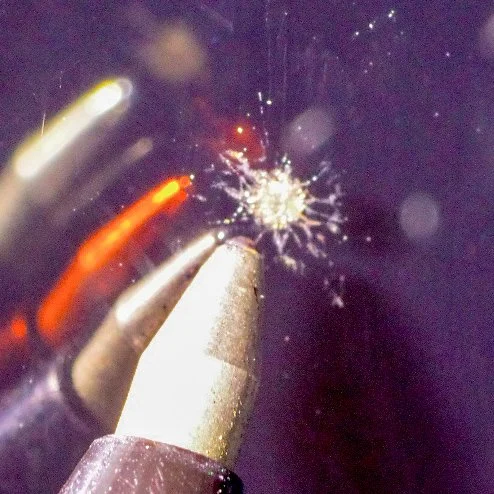
Tile saw chip damage appears as dozens or hundreds of tiny chips, pits, and micro-fractures scattered across the glass surface in a fan-shaped pattern that follows the direction the saw was exhausting. Unlike scratches which have smooth edges, tile saw chips have sharp irregular margins under magnification and a characteristic pattern that is immediately recognizable to an experienced restorer. The affected area typically covers a significant portion of the glass surface and the chips vary in size from barely visible to several millimeters across depending on the tile material being cut and the distance from the saw to the glass.
What Causes It Chips in Glass?
A tile saw cutting ceramic, porcelain, or stone exhausts a high-velocity spray of abrasive particles, water, and cutting debris in a continuous stream during operation. When a tile setter positions their saw near finished glass without adequate protection — or worse, facing the glass — every cut sends thousands of micro-projectiles directly into the glass surface at high speed. Each particle that contacts the glass chips away a microscopic piece of the surface. Over the course of a full tile installation job the cumulative damage can render an entire sliding glass door or window beyond repair. We have seen this condition destroy brand new impact-rated sliders that cost thousands of dollars to replace. It is entirely preventable with a simple barrier. It happens constantly because tile setters don't think about it until the damage is done.
Can It Be Fixed?
Tile saw chip damage is one of the most difficult conditions we encounter because the damage is not a continuous scratch that can be systematically ground and polished — it is thousands of individual impact points each with its own depth and geometry. Shallow chip patterns in limited areas can sometimes be improved to an acceptable standard. Extensive chip damage covering large glass surfaces is typically beyond restoration and requires replacement. The determining factors are chip depth, chip density, and location on the glass. Glass Restoration Inc. assesses tile saw damage on site and will give you an honest evaluation of whether improvement is achievable — and what acceptable means in the context of your specific glass and viewing conditions.
How to Prevent It — Two Solutions That Cost Almost Nothing
Tile saw chip damage is one of the most expensive and heartbreaking construction glass failures we encounter — and it is completely avoidable with two minutes of preparation. Option one: tape 6-mil plastic sheeting over any finished glass within 10 feet of the saw before the first cut. The plastic costs pennies per square foot and stops every particle before it reaches the glass. Option two: turn the saw around so the exhaust faces away from the glass. That's it. No cost. No materials. Just awareness. The entire problem exists because tile setters focus on the tile and forget about the glass behind them. A superintendent who walks the job before tile work begins and reminds the crew of these two simple steps eliminates this damage condition entirely. Glass Restoration Inc. has replaced thousands of dollars worth of impact glass that a two-dollar piece of plastic would have saved. Don't let it happen on your job.
A direct word to tile setters and paver installers: we see your work on a regular basis — and not in a good way. The chip pattern left by a tile or paver saw is distinctive and immediately identifiable. When Glass Restoration Inc. is called to assess construction glass damage and we find this pattern, the cause is never in question. The liability is never in question either. Protecting the glass before you start your saw takes two minutes. Explaining to a homeowner, builder, or general contractor why their brand new impact-rated slider needs to be replaced because of your negligence takes considerably longer — and costs considerably more. Cover the glass. Turn the saw around. It is that simple.
Metal Spark Embedding, AKA Metal Burn — When 5000-Degree Particles Meet Glass
What It Looks Like and Feels Like
Metal spark embedding has a distinctive look and feel that sets it apart from every other glass damage condition. Run your finger across the affected area and it feels like stubble on an unshaved face — tiny metal whiskers protruding from the glass surface where each spark embedded and solidified. Visually the initial damage appears as small dark metallic spots scattered across the glass in the pattern of the cutting arc. But over time those embedded metal particles begin to oxidize. The metal rusts. And as it rusts it runs — leaving dark reddish-brown streaks running down the glass surface from each embedded spark point. By the time most homeowners or property managers call us they are seeing both the stubble and the rust trails simultaneously. The rust streaking is often mistaken for a cleaning problem or water staining — but no cleaning product touches it because the source is not on the surface. It is in the glass.
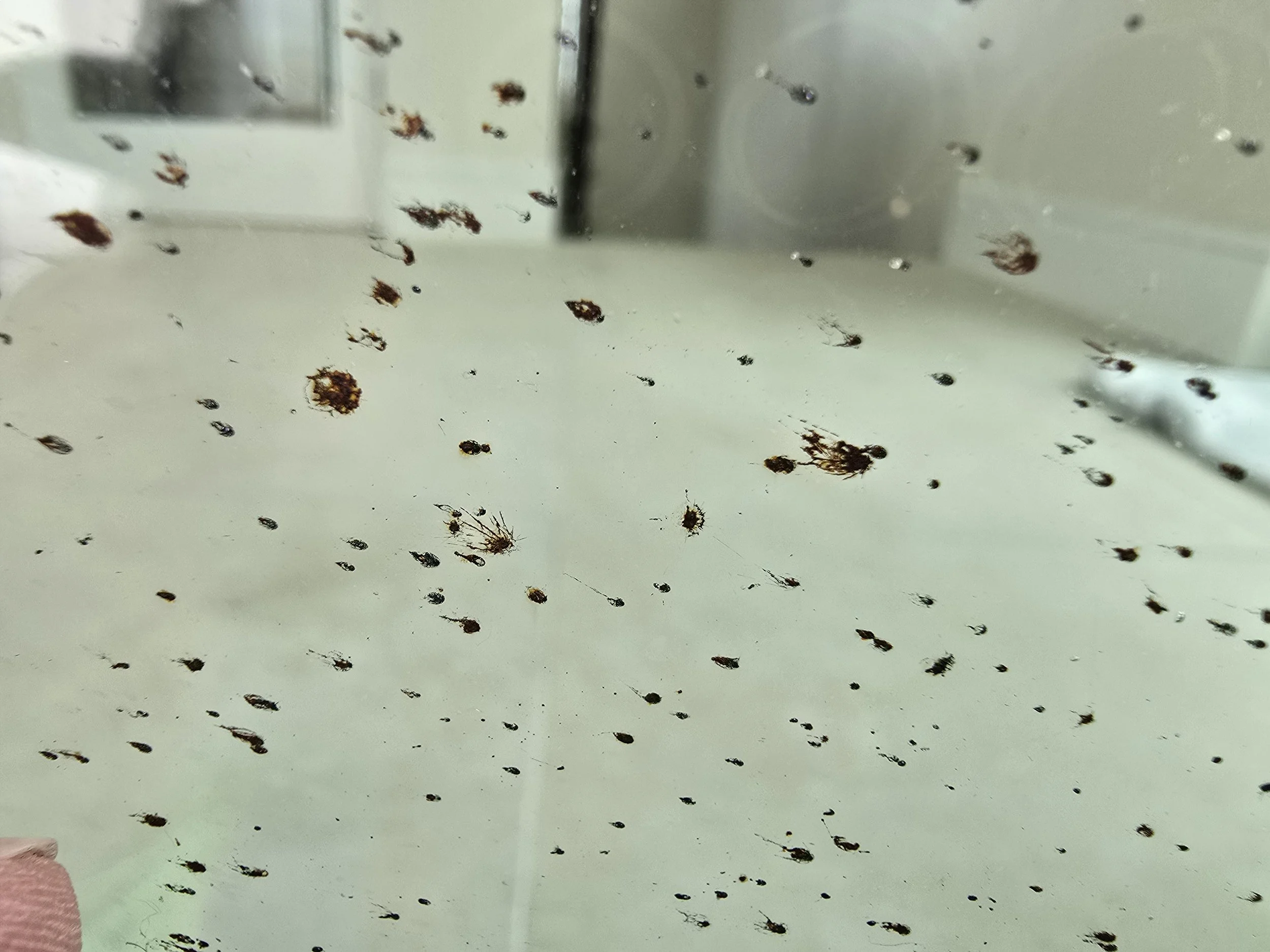
Sparks from a jobsite saw or cutting torch can land on unprotected glass and burn straight into the surface — hot enough to leave permanent pitting that no amount of polishing will remove. Protecting glass before cutting or welding nearby isn't optional. (0:32)
The Value of an Honest Assessment
Every condition documented on this page has one thing in common — it requires an experienced specialist to correctly identify it, accurately assess its severity, and give an honest opinion about what is and is not possible. Glass Restoration Inc. has encountered every one of these conditions multiple times over 40 years of field work. We have seen them misdiagnosed by replacement companies who said everything needs replacing. We have seen them mishandled by restoration companies who attempted work they should not have started. And we have seen homeowners, builders, property managers, and attorneys left with damaged glass, wasted money, and no straight answers.
Our assessment process begins with looking at the glass — not at what we can charge for it. If your damage is fully restorable we will restore it. If it can be improved to an acceptable standard we will tell you what that standard looks like before we start. If it is beyond any intervention we will tell you that on the first visit and save you the cost of attempting the impossible. That honesty is not a liability. It is the foundation of every relationship we have built over 21 years in business.
Glass Damage Assessment for Legal & Insurance Purposes
The conditions documented on this page are frequently at the center of construction defect litigation, insurance claims, and property damage disputes. Correctly identifying the cause of glass damage — distinguishing tile saw chip damage from welder slag burns, or metal spark embedding from surface scratches — requires field experience and technical knowledge that most glass companies and general inspectors do not possess. Glass Restoration Inc. serves as an expert witness in glass damage litigation and insurance assessment. Barry Barbas has been qualified as a glass damage expert in Florida court proceedings and is currently retained by Nelson Forensics LLC of Miami for a construction defect assessment involving concrete overspray damage at a 1961 building in Edgewater Miami. If you are an attorney, forensic engineer, or insurance adjuster requiring a credentialed glass damage expert — contact us or visit our Legal page for full credentials and engagement details.