
Manufacturer Glass Defects & Coating Issues — What the Manufacturer Won't Tell Your Builder
Glass manufacturers produce excellent products. But like every industry they have products, coatings, and specifications that create real-world problems they don't volunteer to the builders who specify them or the homeowners who live with the consequences. Glass Restoration Inc. has encountered every condition on this page repeatedly over 40 years of Gulf Coast field work. We have no financial relationship with any glass manufacturer. We have no incentive to protect their reputation at the expense of your building project or your home. What follows is field intelligence — documented from actual jobs, actual damage, and actual conversations with builders and homeowners who were never told what they needed to know before they specified or accepted these products.
Some of these conditions are warranty issues that manufacturers will address if you know to ask. Others are specification decisions that builders can avoid entirely. And some are simply the reality of products that sound better on paper than they perform in the field. In every case the information on this page gives you the knowledge to make better decisions — before the glass is installed, before the damage happens, and before someone tells you there is nothing that can be done.
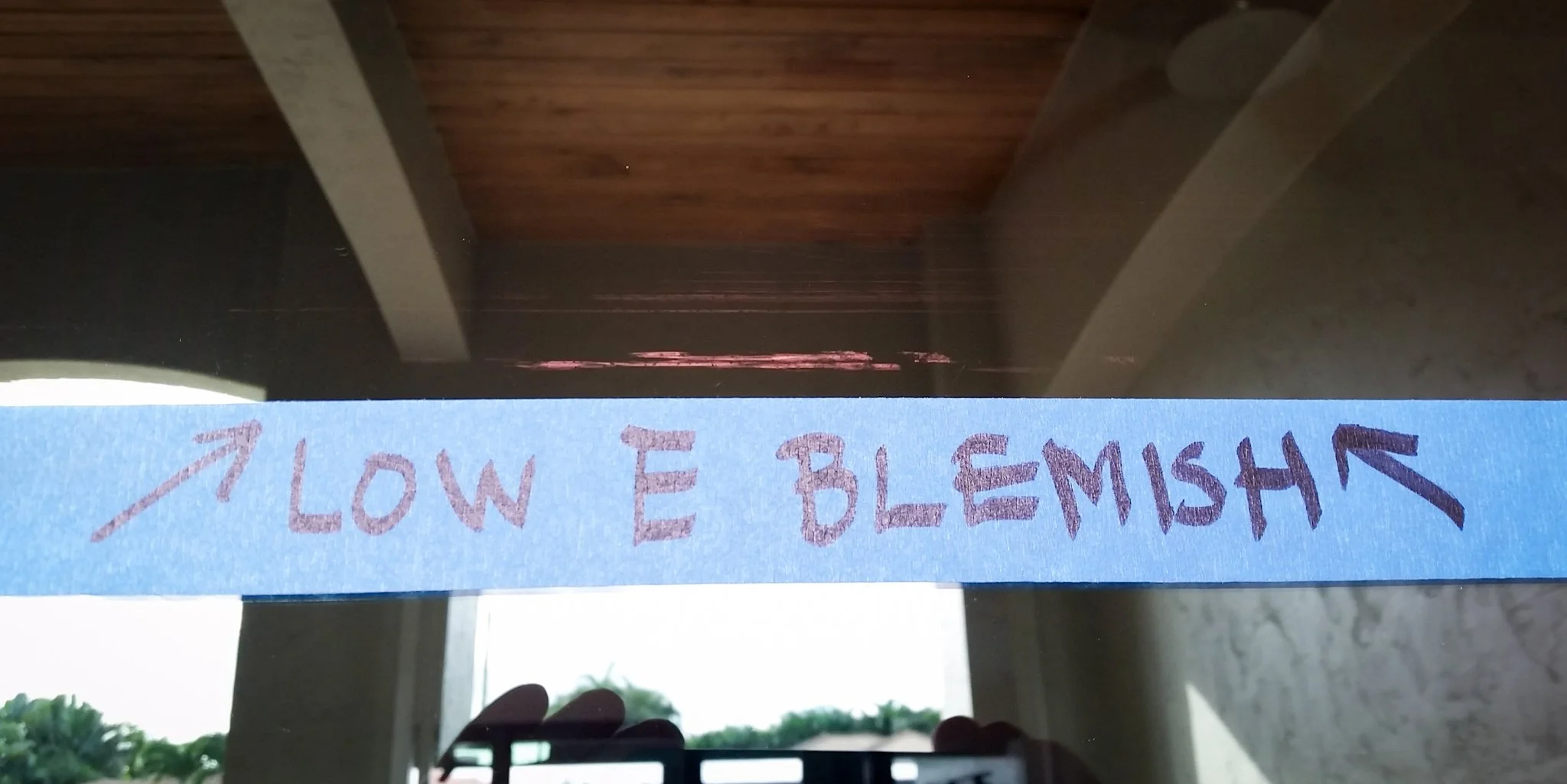
Low-E Coating Blemishes — The Defect Your Builder May Not Notice
What It Looks Like
Low-E coating blemishes appear as patches of brown, purple, or green discoloration on the glass surface — areas where the low-emissivity coating has failed, degraded, or was improperly applied during manufacturing. The color and intensity varies depending on lighting conditions and viewing angle. Some blemishes are only visible from the exterior under certain light conditions and go unnoticed during a standard walk-through inspection. Others are clearly visible from both sides of the glass and sit directly in the primary view zone — impossible to miss once you know what you are looking at.
Is It a Warranty Issue?
Whether a Low-E blemish constitutes a warranty replacement depends on two factors — size and location. Manufacturers apply minimum size thresholds and location criteria to warranty claims. A small blemish in the corner of a pane outside the primary view zone may fall below the warranty threshold. A blemish of significant size sitting in the center of a picture window or slider panel in the primary view zone is a clear warranty replacement candidate. The challenge is that manufacturers define these thresholds in their own favor and builders are not always aware of them at the time of installation. Glass Restoration Inc. can assess Low-E blemishes on site and advise whether the condition meets typical warranty replacement criteria — giving you documentation and a professional opinion to support your warranty claim.
Can It Be Restored?
No. Low-E coating blemishes cannot be restored by any field method. The coating failure is within the glass unit itself — not on the accessible surface. The only remedy for a significant Low-E blemish in the view zone is replacement of the glass unit. Do not let anyone attempt to polish or treat a Low-E blemish — it will not improve the condition and may damage the surrounding glass surface.
Cardinal Glass Neat+ Coating — The Product That Makes Scratched Glass Unrestorable
What It Is
Cardinal Glass Neat+ is a hydrophilic coating applied to glass surface 1 or surface 4 — the exterior-facing surfaces of a window or door unit. It is designed to cause water to sheet off the glass rather than bead, keeping the glass cleaner between washings. As a cleaning aid it works as intended. As a specification decision for buildings in active construction environments or high-traffic commercial applications — it creates a serious problem that Cardinal does not prominently disclose to the builders who specify it.
The Problem
Neat+ coated glass that becomes scratched is nearly unrestorable using standard field polishing methods. The coating chemistry interferes with the restoration process in ways that standard uncoated glass does not. Glass Restoration Inc. has encountered Neat+ coated glass on multiple job sites where scratch damage occurred during construction or cleaning — and in every case the restorability of the glass was significantly compromised by the coating. In some cases improvement was marginal at best. In others the glass required replacement where uncoated glass with identical scratch damage would have been fully restorable. No field remedy exists for scratch damage on Neat+ coated glass.
What Builders Should Know
If you are a builder or superintendent specifying Cardinal Glass products — ask specifically whether any glass units in your order carry the Neat+ coating on surface 1 or surface 4. If they do understand that scratch damage on those units during construction will be significantly harder or impossible to restore. In active construction environments where glass damage is a foreseeable risk — and it always is — specifying Neat+ coated glass increases your replacement exposure substantially. Glass Restoration Inc. recommends builders be informed of this limitation before specification and factor it into their glass damage risk assessment for each project.
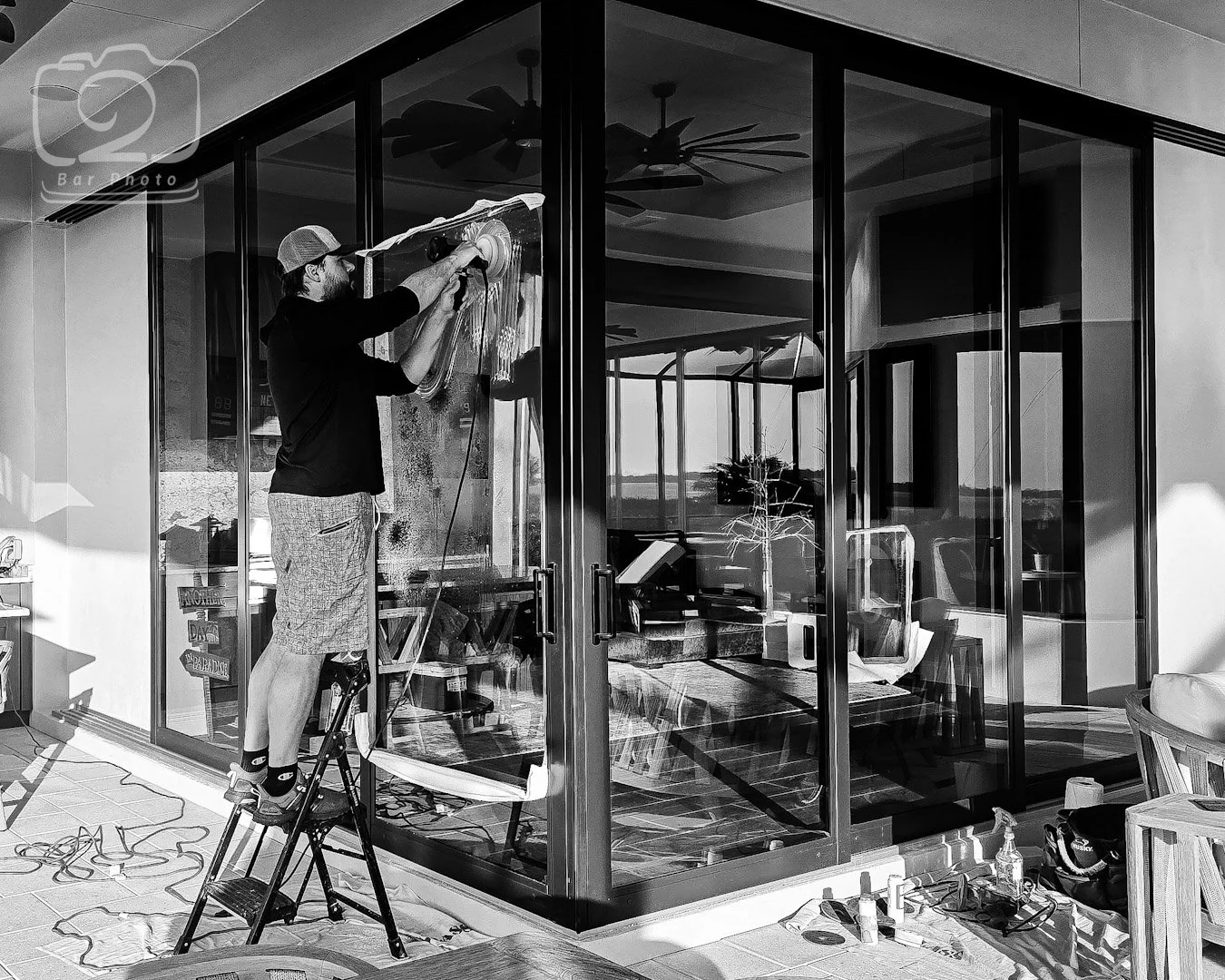
Cardinal Glass Pre-Protected 15-Lite Doors — A Well-Intentioned Product That Creates Scratched Glass
What It Is
Cardinal Glass pre-protected 15-lite doors ship with a full-coverage plastic protective film over each glass lite. The intent is to protect the glass during the painting process so the painter does not need to mask each individual pane. In theory this sounds like a labor-saving convenience. In practice it is one of the most consistent sources of corner scratch damage we encounter on new construction job sites across the Florida Gulf Coast.
The Problem
The plastic film on pre-protected 15-lite doors adheres tightly to the glass surface. By the time the cleaning crew arrives to remove it after painting the film has often been on the glass for weeks in Florida's heat and humidity — bonding more aggressively than it would in cooler conditions. The only practical way to remove it is to knife-cut the edges free before peeling. That knife cut — made by a cleaning crew worker who is focused on speed not precision — nearly always scratches the corners of each glass pane. And those corner scratches cannot be fully repaired. A round polishing disk cannot reach into the corner geometry of a 15-lite pane. The scratch sits exactly where restoration is mechanically impossible.
Glass Restoration Inc.'s Recommendation to Builders
We have recommended to every builder we work with to stop specifying pre-protected 15-lite doors. The protection that sounds like a benefit creates more damage than it prevents. Let the painter do their job and mask the glass edges conventionally — it takes minutes per door and eliminates the corner scratch problem entirely. If Cardinal Glass wanted to solve this problem at the manufacturing level the solution is straightforward — make the protective plastic one inch smaller than the glass pane on all edges. The center of each pane would still be protected during painting. The painter would still need to mask the exposed edges. But the plastic would peel cleanly without knife cutting — and the corner scratch epidemic would end. It is a simple engineering change that would cost Cardinal almost nothing and save builders and homeowners thousands of dollars in glass replacement annually.
Metallic Glass Coatings — Beautiful Until They Get Scratched
What They Are
Gold and silver metallic coatings on architectural glass are visually striking — a premium aesthetic option being specified increasingly on luxury residential and commercial projects across the Gulf Coast. The reflective metallic finish is distinctive and commands a premium price point. What the manufacturer does not always make clear to the builder or homeowner is what happens when that coating gets scratched.
The Problem
Metallic coated glass that becomes scratched is not restorable by any known field method. The coating chemistry is fundamentally different from standard glass coatings and Low-E films — and no field polishing process, chemical treatment, or restoration technique exists that can address scratch damage on gold or silver metallic coated glass surfaces. The scratch is permanent. The only remedy is replacement of the glass unit. This is true regardless of scratch depth, scratch location, or the skill level of the restorer attempting the work. Glass Restoration Inc. has declined metallic coated glass restoration jobs and will continue to do so — because attempting work we know cannot succeed does not serve our clients and does not serve our reputation.
A Note to Builders and Specifiers
Glass Restoration Inc. has been working alongside Florida Gulf Coast builders for 21 years. We have seen the same manufacturer-related glass damage conditions repeat themselves on job after job — not because builders are careless but because the information on this page is not prominently disclosed by the manufacturers who produce these products. Our relationship with builders is built on solving problems. But the best problem is the one that never happens. If any of the conditions documented on this page affect a current or upcoming project — call us. We will give you a straight assessment of your exposure and our honest recommendation before the glass is installed and before the damage is done.
Every recommendation on this page has one purpose — to save builders money. Not just the direct cost of replacing damaged glass, but the hidden cost that starts the moment a warranty manager picks up the phone on a damage complaint. That call triggers a site visit, a damage assessment, a vendor coordination call, a homeowner follow-up, a replacement order, an installation schedule, and a reinspection. By the time a single glass warranty claim is fully resolved the actual cost to the builder is four to ten times the cost of the glass itself. The products and practices documented on this page generate warranty calls at a predictably higher rate than the alternatives. Pre-protected 15-lite doors create corner scratches that generate replacement claims. Neat+ coated glass creates unrestorable scratch damage that drives replacement costs up. Metallic coatings create permanent damage exposure with no field remedy. Choosing products with fewer known failure modes — and requiring trades to protect glass during construction — is not just good practice. It is the most cost-effective decision a builder makes on every project. Glass Restoration Inc. exists to fix what goes wrong. But we would rather help you avoid it.