Clearly Unclear: Understanding Low-E Haze
Condition vs. Flaw in High-Performance Glass
The Forensic Reality of High-Performance Glass
In the high-end architectural market, the visual clarity of glass is often misunderstood. Homeowners, builders, and architects frequently encounter a "milky" or "smoky" appearance in their windows during specific times of the day. This phenomenon is frequently misdiagnosed as a manufacturing defect.
At Glass Restoration Inc., we act as Glass Problem Solvers. We specialize in identifying the difference between an optical condition and actual glass damage. Before you authorize an expensive unit replacement, it is vital to understand what you are seeing.
In reality, what you are seeing is Low-E Haze.
Low-Emissivity (Low-E) glass is engineered with microscopic metallic coatings to maximize energy efficiency. Under specific solar angles—particularly at sunrise and sunset—these coatings can produce an optical interference that appears as a haze.
This is not a defect. It is a performance characteristic inherent to modern, code-compliant glazing.
The Technical Manuscript
An advisory for builders, architects, and property owners.
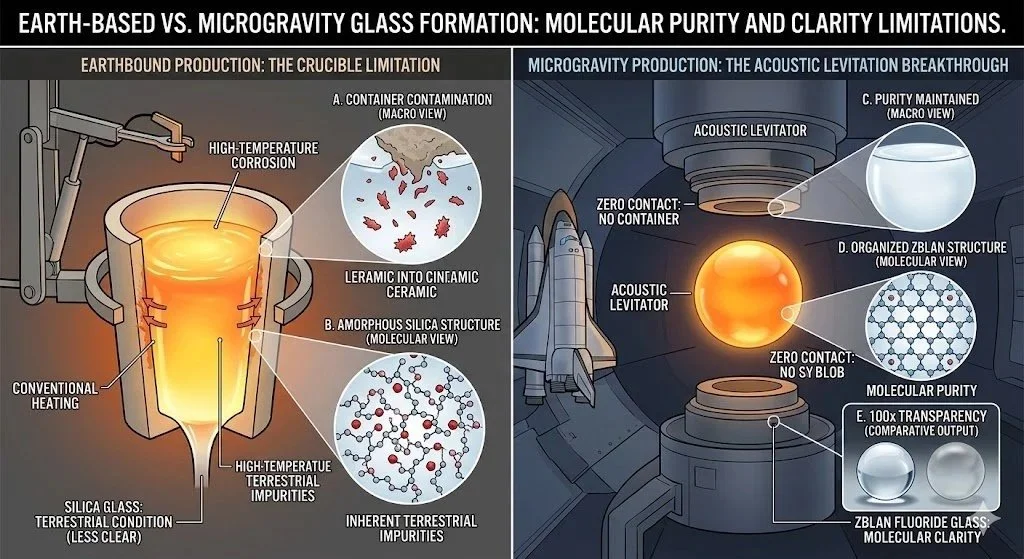
I. The Physics of Clarity: Lessons from Zero Gravity
I. The "Haze Sandwich": Cumulative Refractive Index
In modern high-performance architecture, "Haze" is rarely a defect of a single component. It is the cumulative result of multiple layers required to meet today’s energy and impact codes.
According to ASTM-D1003, haze is the percentage of light that deviates from the incident beam by greater than 2.5 degrees. When the sun is at a low angle (morning or evening), it strikes the glass at a "grazing" angle, maximizing this deviation.
Every layer added to an Insulated Glass (IG) unit increases visual haze:
Low-E Coatings: These metallic layers have a higher refractive index than the glass itself, naturally increasing light scatter. Under ideal conditions, UV light is reflected off the glass and back to the outside heat, where you want it to stay. When the direction of the light is closer to sunrise or sunset, a portion of the light striking the glass and Low-E coating is scattered laterally through the glass. Like a mirror that will show a water drop twice, the mirror effect of the Low-E coating now allows anything on or in the glass to become illuminated, creating the appearance of haze or dirty glass. This is further projected to the inner layers of glass and PVB in the case of Impact-rated glass. Even dust within the air space will become illuminated during that brief lighting condition. It is an unavoidable condition, not a flaw.
Laminate Interlayers (PVB/SGP): The dense plastic layer required for impact resistance adds another medium for light to pass through.
Argon Gas & Multiple Panes: Each additional surface provides two more points of contact where light can be diverted.
II. The Cost of Misdiagnosis: A Quail West Case Study
Experience in the field is the best diagnostic tool. We recently consulted on a high-end estate in Quail West (North Naples), where the property owner and the supplier were locked in a dispute over "hazy" glass.
The supplier, acting on the assumption that the glass was defective, replaced several large units at great expense. Upon completion, the "new" glass exhibited the exact same hazy condition.
This was not a glass problem; it was an optical phenomenon inherent to the glazing specification chosen for the home's orientation. By attempting to "solve" a condition with replacement, the parties involved incurred massive logistical costs for a result that did not improve the view. We were able to diagnose the condition, sparing the owner from further unnecessary and ineffective replacements.
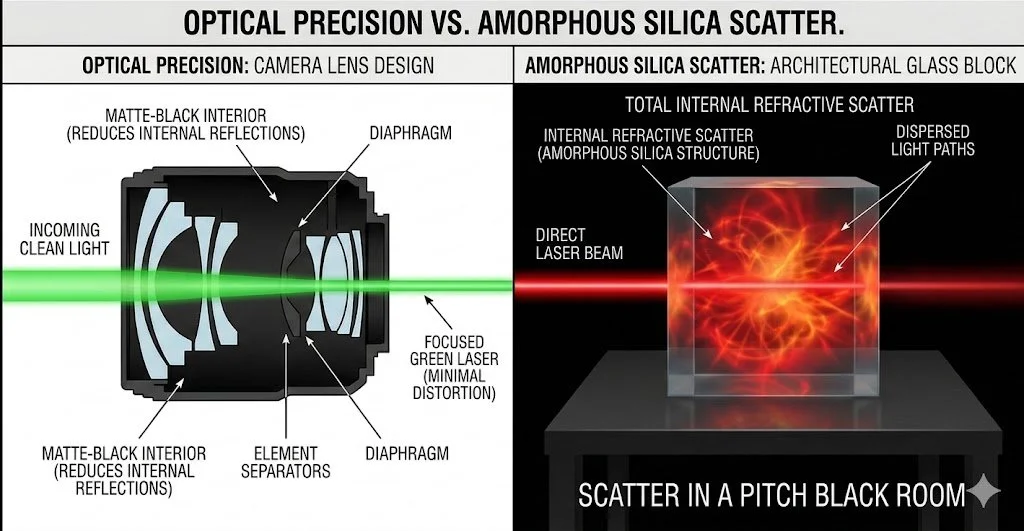
Laser light demonstrating total internal refractive scatter within a standard silica glass block.The Physics of Clarity: Optical Glass vs. Architectural Glazing
To understand why your windows exhibit "haze," it helps to understand what glass actually is. Most people instinctively compare their home windows to the high-end glass found in a camera lens or a telescope. In an ideal world, all glass would meet that standard. However, there is a fundamental difference in manufacturing and cost.
Camera lens glass is engineered for absolute purity and zero refractive deviation; it is an expensive, high-precision medium. In contrast, architectural glass (used in windows and doors) is produced for large-scale structural performance and cost-efficiency. As shown in the laser test above, even "clear" architectural glass contains minute, molecular-level density variations. When a high-intensity light source—like a red laser or a low-angle sun—passes through the glass, these structural imperfections cause the light to deviate and scatter. This is not a "defect" in the sense of a manufacturing failure; it is the physical reality of the material. When you see haze in your home, you are seeing the result of that same light scatter being amplified by the metallic coatings and laminate layers of your modern energy-efficient glazing.
III. Haze vs. Mineral Deposits (Surface Contamination)
As Glass Problem Solvers, we distinguish between intrinsic glass conditions (like Low-E Haze) and extrinsic damage (like mineral deposits).
Low-E Haze is an internal optical condition. It is uniform, predictable based on the sun's position, and generally does not change with manual cleaning.
Mineral Deposits (Hard Water/Etching) are surface-level contaminants. These accumulate over time, often feel rough to the touch, and can permanently etch the glass if not removed.
We possess the specialized equipment and proprietary protocols to remove stubborn mineral deposits and restore the surface—a process that brings clarity back to glass that has been neglected.
If your glass is hazy because of mineral buildup, we can fix it. If it is hazy because of Low-E optical interference, we will tell you, so you don't waste money on a repair or replacement that won't work.
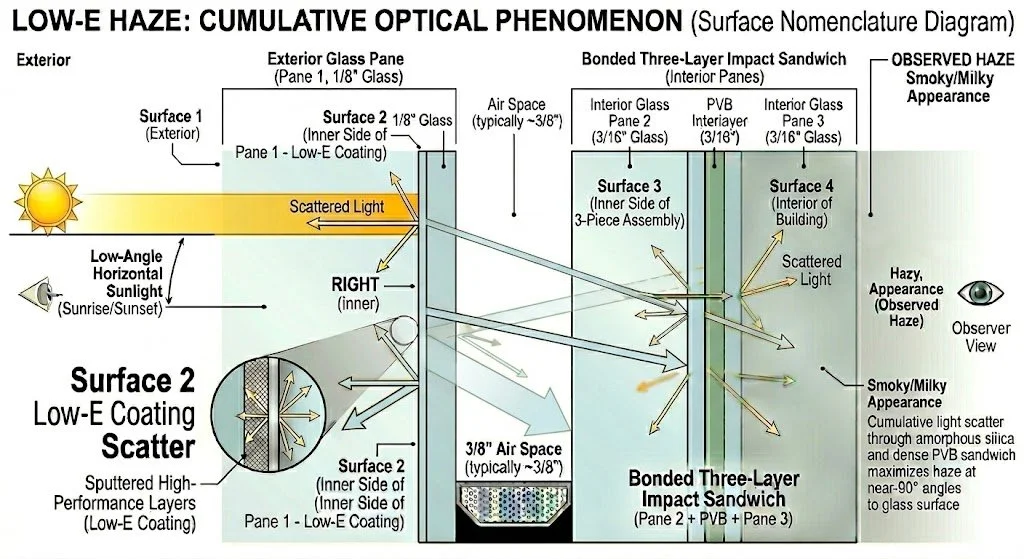
TECHNICAL SCHEMATIC: OPTICAL PHYSICS OF LOW-E HAZE IN IMPACT-RATED GLAZINGThe Shadow Test: A Real-World Comparison
The most striking evidence of refractive haze occurs when a single pane of glass is partially shaded.
In the Shade: The glass appears perfectly transparent and clear. Without direct, high-intensity light hitting the metallic Low-E layers at a grazing angle, there is no significant scatter to meet the eye.
In the Sun: The same pane of glass immediately takes on a "smoky" or "milky" appearance.
This side-by-side comparison confirms that the haze is an optical phenomenon caused by light interaction, not a permanent defect or surface contaminant. If the glass were truly "dirty" or "etched," the condition would remain visible even in the shaded portion of the pane. It is a Condition, not a defect.
III. Haze vs. Mineral Deposits (Surface Contamination)
As Glass Problem Solvers, we distinguish between intrinsic glass conditions (like Low-E Haze) and extrinsic damage (like mineral deposits).
Low-E Haze is an internal optical condition. It is uniform, predictable based on the sun's position, and generally does not change with manual cleaning.
Mineral Deposits (Hard Water/Etching) are surface-level contaminants. These accumulate over time, often feel rough to the touch, and can permanently etch the glass if not removed.
We possess the specialized equipment and proprietary protocols to remove stubborn mineral deposits and restore the surface—a process that brings clarity back to glass that has been neglected.
If your glass is hazy because of mineral buildup, we can fix it. If it is hazy because of Low-E optical interference, we will tell you, so you don't waste money on a repair or replacement that won't work.
V. Forensic Conclusion: Navigating the Limits of Clarity
In the high-end architectural market, "clarity" is often treated as a binary—either the glass is clean or it is defective. As this manuscript demonstrates, the reality is dictated by physics and cumulative refractive indices.
Replacing glass that exhibits this "Low-E Haze" is rarely the answer; because the condition is an inherent byproduct of high-performance Low-E coatings, a replacement unit will likely exhibit the exact same optical characteristics.
The Artisan’s role is to distinguish between manufacturing haze and actual environmental damage. We identify and mitigate factors that exacerbate these conditions, providing the bridge between the limitations of modern manufacturing and the aesthetic standards of demanding properties.
Need an expert assessment of your glass conditions? If you are unsure whether your glass is performing within standard specifications or showing signs of environmental etching, we provide forensic diagnostic services to determine the nature of the condition.
Contact Glass Restoration Inc. for a Professional Assessment