

Crown Glass and Flat Glass
Colored art glass could be small — a goblet, a bead, a vessel. But a window demanded something far harder: glass that was flat, large, and clear enough to see through. For most of history, that problem had no good solution. Early "windows" were often nothing more than animal hide, paper, or thin sheets of mineral stretched over an opening. Getting actual glass into that opening, in a size and clarity worth looking through, took over a thousand years of trial and error to solve.
Crown glass — the first real answer:
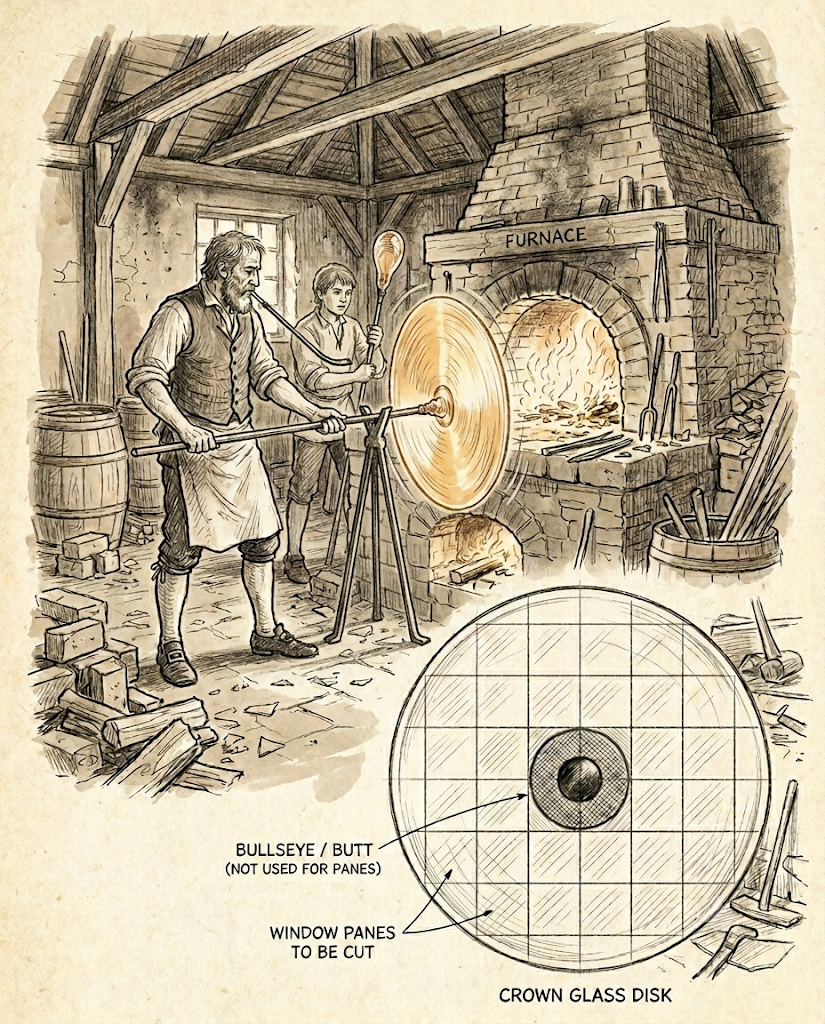
By around the 1300s, glassmakers in France had perfected a technique that would dominate window glass for the next 500 years: crown glass. A glassblower would gather molten glass on the end of a blowpipe, blow it into a bubble, then attach a solid rod (called a pontil) to the opposite side and spin it at extremely high speed. Centrifugal force flattened the spinning bubble into a large, flat disc — sometimes several feet across — while it was still molten. Once cooled, that disc was cut into smaller panes.
This process explains two things people still notice in genuinely old buildings today. First, the wavy, slightly distorted look of old window glass — a side effect of the spinning process, not sagging over time (a myth we already addressed on the main History of Glass page). Second, the reason old homes so often have small, multi-paned windows instead of one large sheet: cutting a spinning disc into panes meant the useful glass came from the outer rings, while the thick, unusable center — the "bullseye," or bull's-eye pane, where the pontil had been attached — was often used decoratively or discarded, and the remaining panes were naturally limited in size by the disc itself.
That same myth has a second half worth clearing up while we're at it — the claim that old windowpanes are thicker at the bottom because the glass slowly "flowed" downward over centuries. It isn't true, and the real explanation has nothing to do with viscosity. When a crown glass disc was cut into panes, the resulting pieces were rarely perfectly uniform in thickness. Experienced glaziers installing that glass knew a simple structural fact: a pane holds up far better, and resists breakage far longer, with its thicker edge set at the bottom. That wasn't an accident of physics slowly working on the glass after installation — it was a deliberate craftsmanship decision made the day the window went in.
Crown glass ruled window-making for roughly 500 years, but it had a hard ceiling built into the process itself — a spinning disc could only ever be so large before centrifugal force stopped cooperating. Plate glass, ground and polished flat by hand instead of spun, solved the size problem, but at enormous cost and labor. It would take until the 20th century, and one manufacturing breakthrough, to finally make large, flawless, affordable flat glass available to everyone — the moment that made virtually every window you see today possible.