
GLASS: CLEARLY UNCLEAR
A Technical Manuscript for Builders, Architects, and Manufacturers
I. The Physics of Clarity: Lessons from Zero Gravity
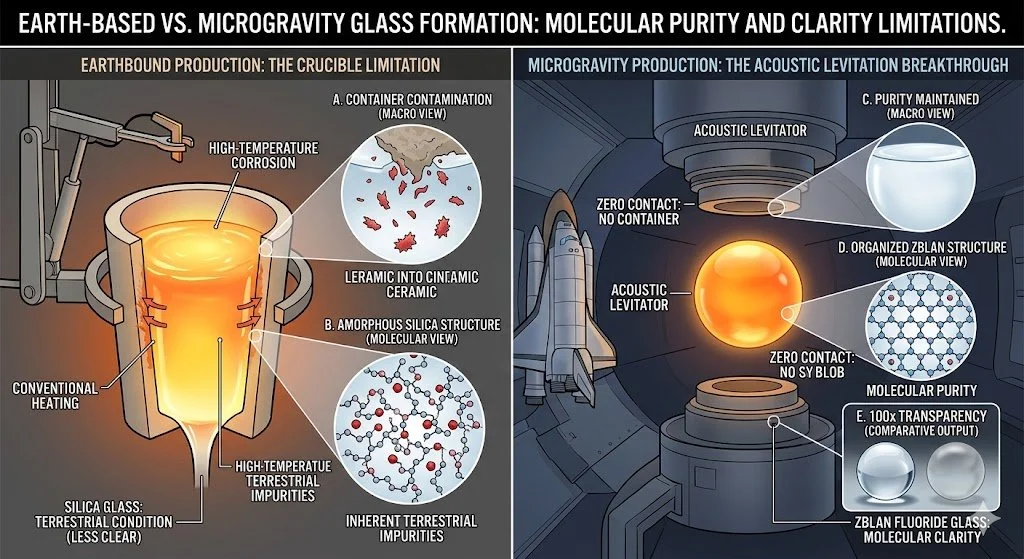
We like to think that glass is absolutely clear, but terrestrial silica-based glass faces significant challenges due to the limitations of Earth's gravity.
The Research: Glass and ceramics expert Delbert Day (Curator's Professor Emeritus, University of Missouri-Rolla) has spent decades experimenting with glass melts on NASA space shuttles. His goal was to achieve a level of purity impossible on Earth.
The Earthbound Limitation: On Earth, molten liquid glass must be held in a container (a crucible). At high temperatures, these melts are so corrosive that they attack and dissolve the container walls, contaminating the glass. In microgravity, NASA achieved "No Contact" production using sound waves (acoustic levitation) to hold the glass in mid-air.
The Result: The space-produced glass (ZBLAN) was 100 times more transparent than the silica-based glass used in our homes and automobiles. This research proves that the glass we see every day is inherently less clear than the "perfect" ideal, containing unavoidable terrestrial impurities and crystallization issues.
II. Refractive Scatter: Optical Precision vs. Amorphous Silica
To understand why high-end architectural glass can appear "smoky" or "milky," we must look at how light interacts with the molecular structure of the material.
The Comparison: In a high-quality camera lens, the interior is finished in matte-black to absorb stray light and minimize internal reflections. This ensures that light passes through the elements with incredible precision. Also, part of the high cost of a good lens is the cost of the highest quality glass. That glass is not used in architectural windows and doors.
The Reality of Silica: Unlike a precision optic, architectural glass has an "amorphous" molecular structure. When a concentrated light source—such as a red laser or a low-angle sun—passes through a block of glass, the light does not travel in a perfectly straight line. Instead, it hits impurities and structural irregularities, scattering in all directions. This internal refractive scatter causes the glass to "glow" or appear hazy, even if the surface is perfectly clean.
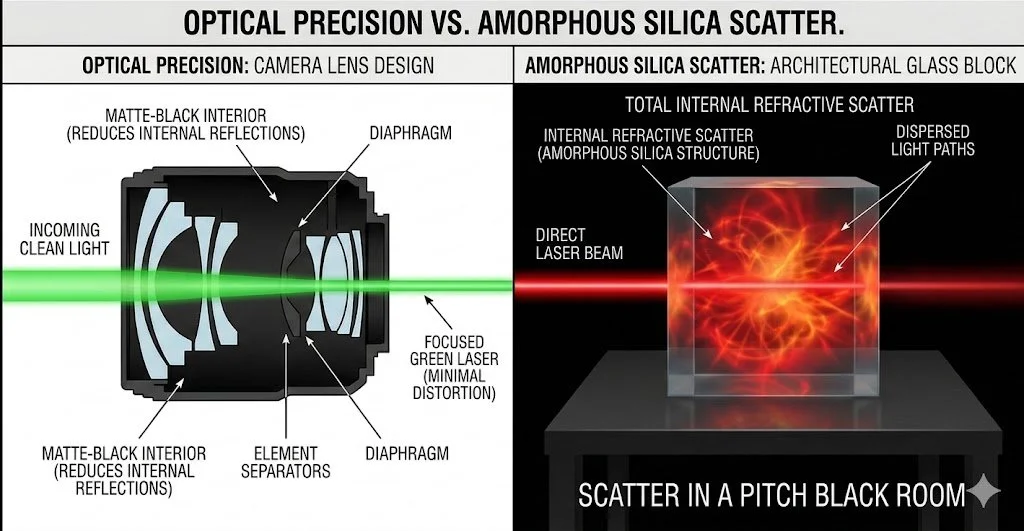
Laser light demonstrating total internal refractive scatter within a standard silica glass block.III. The "Haze Sandwich": Cumulative Refractive Index
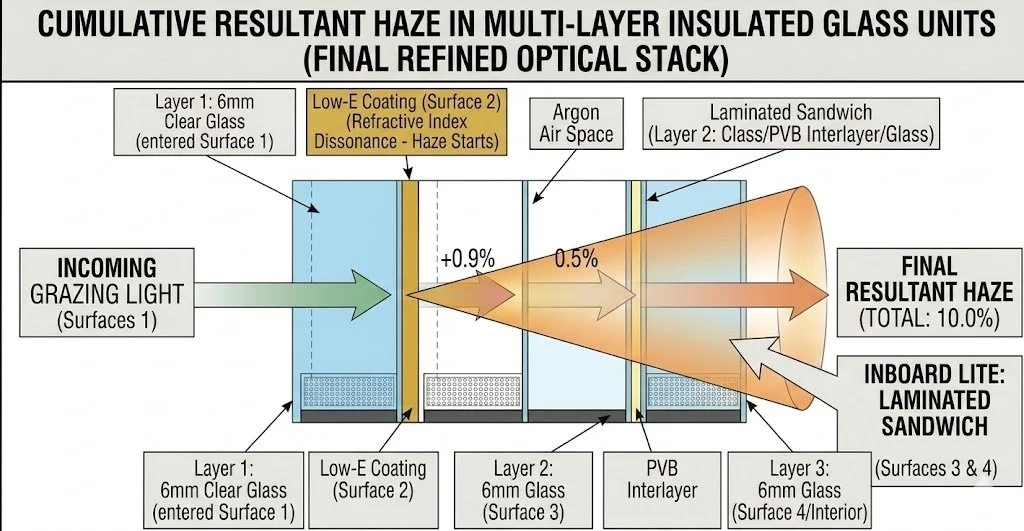
In modern high-performance architecture, "Haze" is rarely a defect of a single component. Instead, it is the cumulative result of multiple layers required to meet today’s energy and impact codes.
What is Haze? According to ASTM-D1003, haze is the percentage of light that deviates from the incident beam by greater than 2.5 degrees. When the sun is at a low angle (morning or evening), it strikes the glass at a "grazing" angle, which maximizes this deviation.
The Cumulative Effect: Every layer added to an Insulated Glass (IG) unit adds to the total visual haze:
Low-E Coatings: These microscopic metallic layers have a higher refractive index than the glass itself, naturally increasing light scatter.
Laminate Interlayers (PVB/SGP): The dense plastic layer required for impact resistance adds another medium for light to pass through, intensifying the "milky" appearance.
Argon Gas & Multiple Panes: Each additional surface provides two more points of contact where light can be diverted.
Conclusion: What appears as a "smoky" film is often the visual proof of a high-performance window doing its job—reflecting heat and providing impact safety.
The Shadow Test: A Real-World Comparison
The most striking evidence of refractive haze occurs when a single pane of glass is partially shaded.
In the Shade: The glass appears perfectly transparent and clear. Without direct, high-intensity light hitting the metallic Low-E layers at a grazing angle, there is no significant scatter to meet the eye.
In the Sun: The same pane of glass immediately takes on a "smoky" or "milky" appearance.
This side-by-side comparison confirms that the haze is an optical phenomenon caused by light interaction, not a permanent defect or surface contaminant. If the glass were truly "dirty" or "etched," the condition would remain visible even in the shaded portion of the pane. It is a Condition, not a defect.
IV. Forensic Conclusion: Navigating the Limits of Clarity
In the high-end architectural market, "clarity" is often treated as a binary—either the glass is clean or it is defective. As this manuscript demonstrates, the reality is dictated by physics, microgravity limitations, and cumulative refractive indices.
The Artisan’s Role: While we cannot change the molecular nature of amorphous silica or the laws of grazing-angle refraction, we can identify and mitigate the factors that exacerbate these conditions. Forensic restoration involves:
Identification: Distinguishing between manufacturing haze, environmental etching, and inherent refractive scatter.
Surface Remediation: Removing sub-microscopic contaminants that increase the surface's "roughness" and contribute to light deviation.
Preservation: Applying advanced hydrophobic barriers to maintain the highest possible level of clarity against Florida’s harsh salt and mineral environment.
Glass Restoration Inc. provides the bridge between the limitations of modern manufacturing and the aesthetic standards of the most demanding residential and commercial properties.